Canada is one of the most visited countries in the world, welcoming over 22 million international tourists each year. People travel to Canada for many reasons: to see family, enjoy nature, attend events, or explore cities like Toronto and Vancouver. If you are planning a trip to Canada and you are not a citizen or permanent resident, you will likely need a Canada Visitor Visa. This visa is also known as a Temporary Resident Visa (TRV). Many people find the application process confusing or worry about making mistakes. This guide will help you understand every step, what to expect, and how to give yourself the best chance of success.
What Is A Canada Visitor Visa?
A Canada Visitor Visa is an official document placed in your passport. It shows that you meet the requirements to enter Canada for a short stay, usually up to six months. The visa does not guarantee entry—border officers at Canadian airports or land borders make the final decision. However, having this visa is a must for most travellers from countries that are not visa-exempt.
There are two main types of visitor visas:
- Single-entry visa – allows you to enter Canada only once.
- Multiple-entry visa – allows you to enter and leave Canada as many times as you want during the visa’s validity period.
Most people get a multiple-entry visa, which is valid for up to 10 years or until your passport expires, whichever comes first.
Who Needs A Canada Visitor Visa?
Not everyone needs a visitor visa to enter Canada. Citizens of some countries can travel to Canada with only an Electronic Travel Authorization (eTA) or just their passport.
You need a visitor visa if:
- You are from a country that is not visa-exempt.
- You are planning to visit Canada for tourism, family, business meetings, or short courses (under six months).
You do NOT need a visitor visa if:
- You are a citizen of a visa-exempt country (for example: UK, Australia, Japan, most EU countries).
- You are travelling directly to the United States or Saint Pierre and Miquelon after your stay in Canada and you meet special requirements.
If you are unsure, check the full list of visa-exempt and non-exempt countries on the official Immigration, Refugees and Citizenship Canada (IRCC) website.
Main Reasons People Apply For A Canada Visitor Visa
People apply for a visitor visa for different reasons. Some common examples include:
- Tourism: To see famous places like Niagara Falls or Banff National Park.
- Family visits: To visit children, parents, or relatives living in Canada.
- Business: To attend meetings, conferences, or trade shows.
- Short studies: To take a course or program that lasts less than six months.
- Transit: To pass through Canada on the way to another country.
It is important to be clear about your reason when you apply, as the documents you need may change based on your purpose.
Eligibility Requirements For A Canada Visitor Visa
The Canadian government checks several things before granting a visitor visa. Here are the main requirements you must meet:
- Valid passport: Your passport must be valid for the whole time you plan to stay in Canada.
- Good health: In some cases, you may need a medical exam, especially if you plan to stay for more than six months or are from certain countries.
- No criminal or immigration-related convictions: A past criminal record can make you ineligible.
- Enough money: You need to show you can support yourself (and your family, if they come with you) during your stay.
- Strong ties to your home country: Proof that you will return home after your visit, such as a job, family, property, or school.
- Purpose of visit: Clearly explain why you want to visit Canada.
Many applications are refused because applicants do not convince officers that they will leave Canada after their visit. Make sure you show strong ties to your home country.
Documents Needed For A Canada Visitor Visa
The exact documents you need may change depending on your country, the type of visit, and your personal situation. However, most people will need:
- Application form (IMM 5257): Completed and signed.
- Valid passport: With at least one blank page (not the last page).
- Proof of funds: Bank statements, pay slips, or employment letters.
- Photographs: As per Canadian visa photo requirements.
- Purpose of travel: Invitation letter, travel itinerary, or business documents.
- Proof of ties to home country: Job letter, school enrolment, property documents, or family evidence.
- Previous travel history: Copies of visas and stamps from past trips (if available).
- Visa fee payment receipt: Proof you paid the application fee.
- Additional documents: Medical exam, police certificates, or biometrics (if asked).
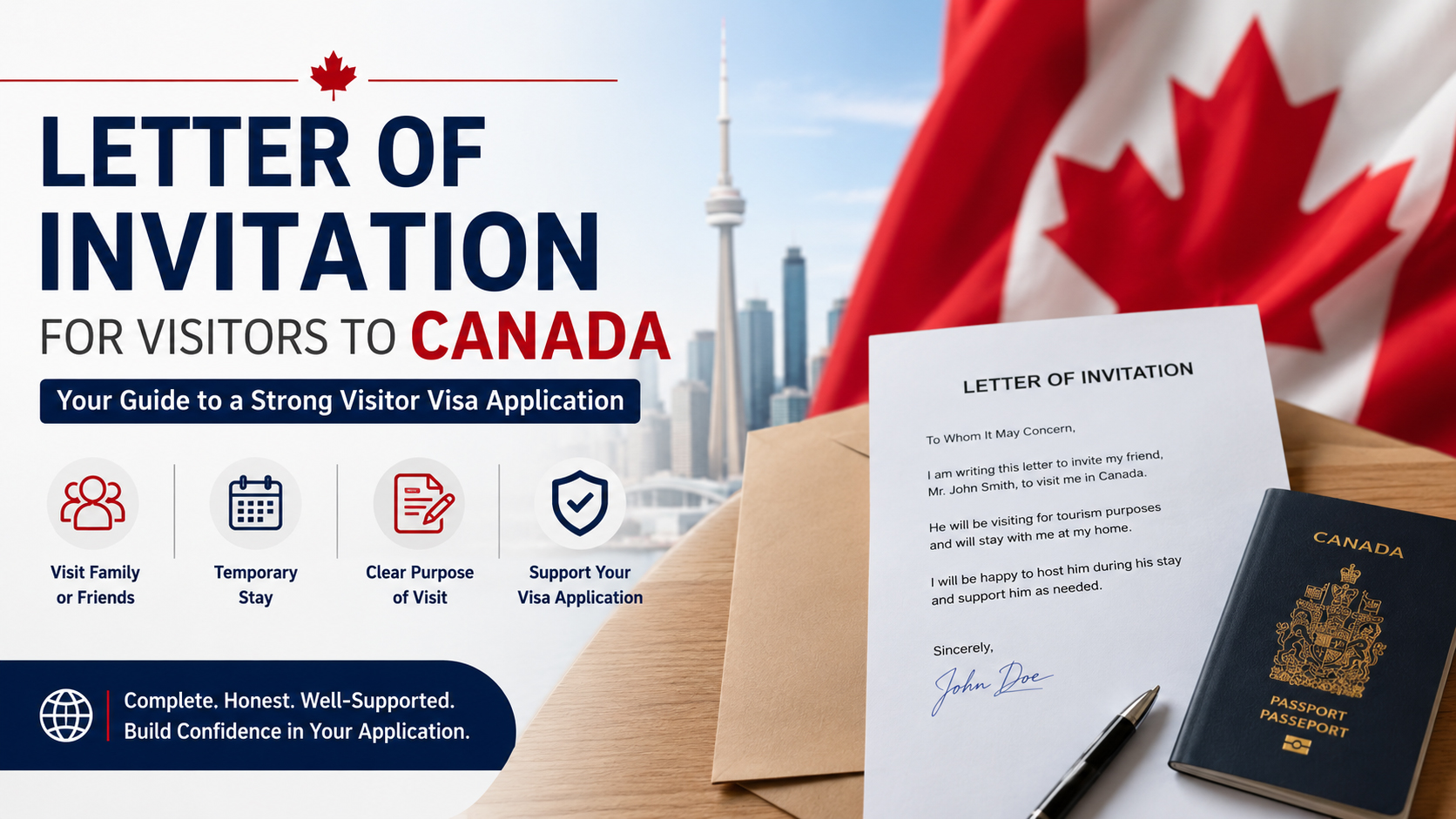
If you are visiting family or friends, an invitation letter from your host in Canada is very helpful. This letter should include their full name, address, relationship to you, and details about your visit.
Canada Visitor Visa Application Process
Applying for a Canada Visitor Visa involves several steps. Following them carefully increases your chances of approval.
Step 1: Determine How You Will Apply
You can apply:
- Online: Most popular and fastest way. You need a scanner or camera and a credit/debit card.
- On paper: If you cannot apply online, you can submit a paper application at a Visa Application Centre (VAC) in your country.
Step 2: Gather Required Documents
Collect all documents before you start. Missing or incorrect papers can delay or even refuse your application.
Step 3: Create An Ircc Account (for Online Applications)
Go to the IRCC website and create a secure account. This is where you will fill out your forms, upload documents, and track your application.
Step 4: Fill Out The Application
Complete the IMM 5257 form and any other required forms. Double-check for accuracy.
Step 5: Pay The Fees
The standard fee is $100 CAD per person. If biometrics are needed, there is an extra $85 CAD fee per person or $170 CAD per family.
Step 6: Submit Your Application
Upload your forms and documents through your IRCC account or submit them at a VAC.
Step 7: Give Biometrics (if Required)
Most applicants must provide fingerprints and a photo at a local VAC or Application Support Center.
Step 8: Wait For A Decision
Processing times depend on your country and how busy the visa office is. Most applications are processed within a few weeks, but it can take longer.
Step 9: Send Your Passport (if Approved)
If your visa is approved, you will be asked to send your passport for the visa sticker.
Step 10: Receive Your Visa And Prepare To Travel
Once you get your passport back, check the visa details for any mistakes. Now you are ready to plan your trip to Canada.
Canada Visitor Visa Processing Times
Processing times can vary a lot. It depends on your country, the time of year, and your own documents. On average, most visitor visa applications are processed in 14 to 30 days. Sometimes, it can take longer if extra documents or an interview is needed.
Here is a sample of average processing times for some countries:
| Country | Average Processing Time |
|---|---|
| India | 28 days |
| Nigeria | 60 days |
| Philippines | 17 days |
| United Kingdom | 10 days |
| Brazil | 20 days |
Remember, these times can change often. It is always best to apply at least two months before your planned trip.
Canada Visitor Visa Fees And Costs
The main fees for a Canada Visitor Visa are:
- Application fee: $100 CAD per person
- Biometrics fee: $85 CAD per person or $170 CAD per family (if required)
Other possible costs:
- Visa Application Centre service charges
- Courier fees (for sending passports)
- Medical exam (if required)
- Police certificates (if required)
- Translation fees (for documents not in English or French)
Here is a simple comparison of costs for a single applicant and a family of four:
| Cost Item | Single Applicant | Family of Four |
|---|---|---|
| Application Fee | $100 CAD | $400 CAD |
| Biometrics Fee | $85 CAD | $170 CAD |
| Total | $185 CAD | $570 CAD |
Make sure to keep all receipts as proof of payment.
Tips For A Successful Canada Visitor Visa Application
Many applications are refused because of small mistakes. Here are some practical tips to improve your chances:
- Be honest: Never give false information or fake documents.
- Show strong ties: Prove you have reasons to return home (job, family, property).
- Explain your travel plan: Give a clear and detailed itinerary.
- Financial proof: Show enough money for your stay and return trip.
- Invitation letter: If visiting family or friends, a strong letter helps.
- Travel history: If you have travelled to other countries and returned on time, include those visas and stamps.
- Cover letter: Write a simple letter explaining your plans, your ties to home, and your intention to leave Canada after your visit.
- Double-check forms: Mistakes in forms can delay or hurt your application.
- Apply early: Processing can take longer than you expect.
- Organize documents: Keep everything clear, labelled, and easy to find.
Non-obvious insight: Many applicants forget to explain why they are not bringing their whole family or why they are travelling alone. Officers sometimes see this as a risk. If you are leaving close family behind, explain clearly in your cover letter why they are not coming and what keeps them at home (such as work, school, or care needs).
Another thing: If you have been refused a visa before for any country, be sure to explain what has changed since then. Ignoring past refusals can raise red flags.
Common Reasons For Canada Visitor Visa Refusal
Getting a refusal can be frustrating and costly. Here are the most common reasons applications are refused:
- Weak ties to home country: Not enough proof you will return home.
- Insufficient funds: Not enough money to pay for your trip.
- Unclear purpose of visit: Travel plans are vague or not believable.
- Incomplete application: Missing or incorrect documents.
- Poor travel history: Overstayed visas in other countries or no travel history at all.
- Previous immigration violations: Past problems in Canada or other countries.
- Inconsistent information: Details in your application or documents do not match.
If you receive a refusal, you can apply again. But be sure to address the reasons for refusal in your new application.
After You Get Your Canada Visitor Visa
Once you receive your visa, you are almost ready to travel. Here is what you should do next:
- Check the visa: Make sure your name, passport number, and dates are correct.
- Plan your arrival: You must arrive before your visa expires.
- Prepare documents for entry: Bring your passport, visa, invitation letter, proof of funds, and return ticket.
- Know your rights and limits: You cannot work or study for more than six months on a visitor visa.
At the Canadian border, you must answer questions about your trip. Be polite, answer honestly, and show your documents if asked.
Non-obvious insight: Even with a visa, the border officer can refuse you entry if they think your real purpose is not tourism or visiting. Always have clear answers and supporting documents ready.
Extending Your Stay In Canada
If you want to stay longer than your visa allows, you must apply for an extension before your current status expires. This is called applying for a visitor record.
Key points about extensions:
- Apply at least 30 days before your status expires.
- You must explain why you want to stay longer.
- You still cannot work or study unless you get special permission.
- If your extension is approved, you get a new document but not a new visa sticker in your passport.
If your extension is refused, you must leave Canada as soon as possible.
Super Visa: Special Option For Parents And Grandparents
If you want your parents or grandparents to visit you in Canada for a longer time, they may be eligible for a Super Visa. This visa allows visits for up to two years at a time, and it is valid for up to 10 years.
Super Visa requirements:
- The child or grandchild must be a Canadian citizen or permanent resident.
- Proof of relationship.
- Invitation letter promising support.
- Minimum income requirement for the host.
- Medical insurance from a Canadian company.
- Medical exam.
The Super Visa is different from a regular visitor visa and has more strict requirements. But it is a good option for families who want longer visits.
Canada Visitor Visa Vs. Eta
Some travellers are confused about the difference between a visitor visa and an Electronic Travel Authorization (eTA). Here is a quick comparison:
| Feature | Visitor Visa (TRV) | eTA |
|---|---|---|
| Who needs it? | Citizens of non-exempt countries | Visa-exempt (except USA) flying to Canada |
| Application process | Online or paper, more documents | Simple online form |
| Processing time | 1–8 weeks | Minutes to hours |
| Validity | Up to 10 years | Up to 5 years |
| Entry type | Air, land, sea | Air only |
| Fee | $100 CAD | $7 CAD |
If you are not sure which one you need, check the IRCC website or speak with a visa expert.
What To Expect At The Canadian Border
When you arrive in Canada, you will meet a border services officer. They will ask questions such as:
- What is the purpose of your visit?
- How long will you stay?
- Where will you stay?
- Do you have enough money?
They may also ask to see your documents, including your return ticket, proof of funds, and invitation letter. Sometimes, they may check your luggage. If everything is in order, they will stamp your passport and let you enter.
If you cannot answer the questions or your documents do not match your story, you could be refused entry—even if you have a visa.
Travelling With Children
If you are travelling with children under 18, there are special rules. You should carry:
- Birth certificate for each child.
- Consent letter from the other parent if you are travelling alone with your child.
- Adoption or custody documents if applicable.
Canadian border officers are very careful about child safety. Having the right documents helps avoid delays or problems at the border.
Can You Work Or Study On A Visitor Visa?
A visitor visa does not allow you to work in Canada. You can study, but only if your course is six months or less. If you want to work or take a longer program, you must apply for a separate work permit or study permit.
Some visitors try to work without permission. This is illegal and can result in removal from Canada and bans on future travel.
Medical Exams And Insurance
Most visitors do not need a medical exam. However, you may need one if:
- You plan to stay more than six months.
- You lived in or visited certain countries for more than six months in the past year.
- You plan to work in health care, child care, or teaching.
Medical insurance is not required for a regular visitor visa, but it is strongly recommended. Health care in Canada is expensive for visitors. Even a simple doctor’s visit can cost hundreds of dollars. It is wise to buy travel medical insurance before you leave home.
Practical Examples: Sample Scenarios
Example 1: Maria from Brazil wants to visit her sister in Toronto for two months. She includes her job contract, bank statements, a letter from her sister, and her return flight ticket. She is approved because she clearly shows she will return home.
Example 2: Ahmed from Egypt applies without a letter from his employer or proof of funds. His purpose of visit is unclear. He is refused because he does not prove strong ties to home or enough money.
Example 3: Li from China wants to attend a one-week business conference in Vancouver. She includes a letter from her company, conference registration, and past travel history. She is approved.
How To Reapply After A Refusal
If your application is refused, do not panic. You can reapply, but you must fix the problems that caused the refusal.
- Carefully read the refusal letter and note the reasons.
- Gather new or stronger documents to address those reasons.
- Write a new cover letter explaining what has changed.
- Apply again, paying the fees.
If you do not understand the refusal, consider getting advice from a licensed immigration consultant or lawyer.
Where To Get More Information
For the latest rules, country lists, and official forms, always check the IRCC website. They update requirements and processing times often. You can also find trusted updates on Government of Canada.