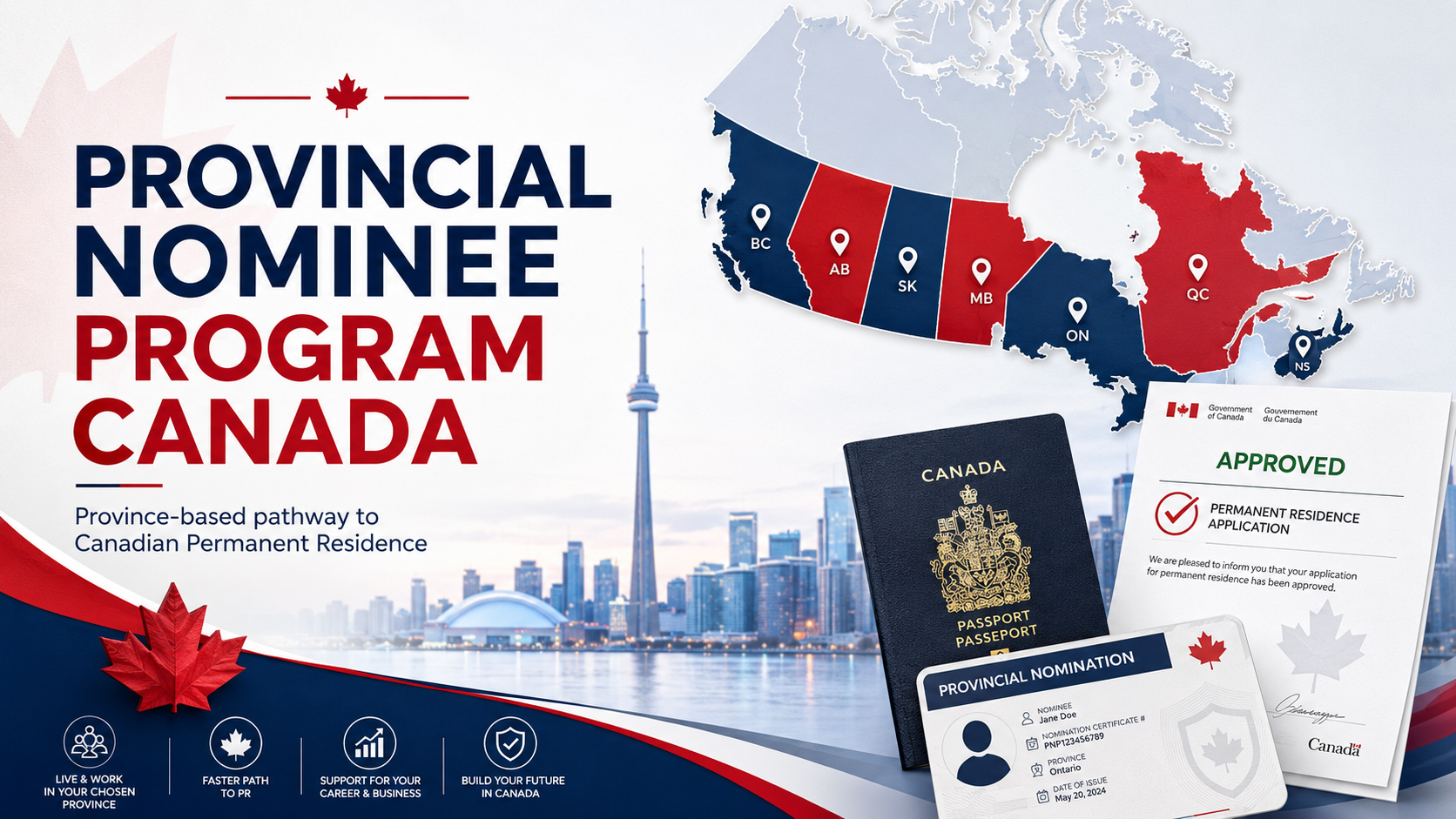
Canada is one of the most popular destinations for skilled workers, international graduates, entrepreneurs, and families who want to build a better future. While Express Entry is one of the most well-known immigration pathways, many applicants also explore the Provincial Nominee Program, commonly known as PNP.
The Provincial Nominee Program allows participating Canadian provinces and territories to nominate applicants who can support their local economy, labour market, and community needs. If you have the right skills, work experience, education, job offer, or connection to a province, PNP may be a strong pathway toward Canadian permanent residence.
However, PNP is not a one-size-fits-all program. Each province and territory has its own immigration streams, eligibility rules, document requirements, and selection priorities. That is why understanding the process before applying is very important.
What Is the Provincial Nominee Program?
The Provincial Nominee Program is an immigration pathway that allows Canadian provinces and territories to nominate eligible foreign nationals for permanent residence. The purpose of the program is to help provinces and territories select candidates who have the potential to live, work, and contribute to that region.
Through PNP, provinces can target applicants based on local needs. For example, one province may prioritize healthcare workers, while another may focus on tradespeople, truck drivers, tech workers, international graduates, or entrepreneurs.
IRCC states that there are two main ways to apply for permanent residence through PNP: the Express Entry process and the non-Express Entry process. The province or territory will usually let the applicant know which process applies to their selected stream.
Why Canada Uses the Provincial Nominee Program
Canada is a large country, and every province has different economic and labour market needs. Some provinces may need skilled workers in construction, agriculture, transport, healthcare, early childhood education, technology, hospitality, or business sectors. PNP helps provinces select applicants who match those local needs.
This makes the immigration system more flexible. Instead of relying only on federal selection, provinces and territories can identify candidates who are more likely to settle successfully in their region.
For non-Express Entry PNP, IRCC explains that provinces review applicants based on their immigration needs, whether the applicant meets the stream requirements, and whether the applicant genuinely plans to live in that province or territory.
Who Can Apply for PNP?
PNP eligibility depends on the province, territory, and stream. In general, applicants may qualify based on factors such as work experience, education, language ability, settlement funds, job offer, previous study in Canada, previous work in Canada, or family connection in a province.
Common applicant groups include:
Skilled workers with experience in in-demand occupations
International graduates from Canadian institutions
Workers with job offers from eligible employers
Semi-skilled or intermediate-skilled workers in selected sectors
Express Entry candidates with provincial interest
Entrepreneurs and business applicants
Applicants with a strong connection to a specific province
For Express Entry-linked PNP, the applicant must be eligible for one of the province or territory’s PNP programs, be nominated by the province or territory, and also be eligible for one of the three Express Entry-managed programs: Federal Skilled Worker Program, Federal Skilled Trades Program, or Canadian Experience Class.
Participating Provinces and Territories
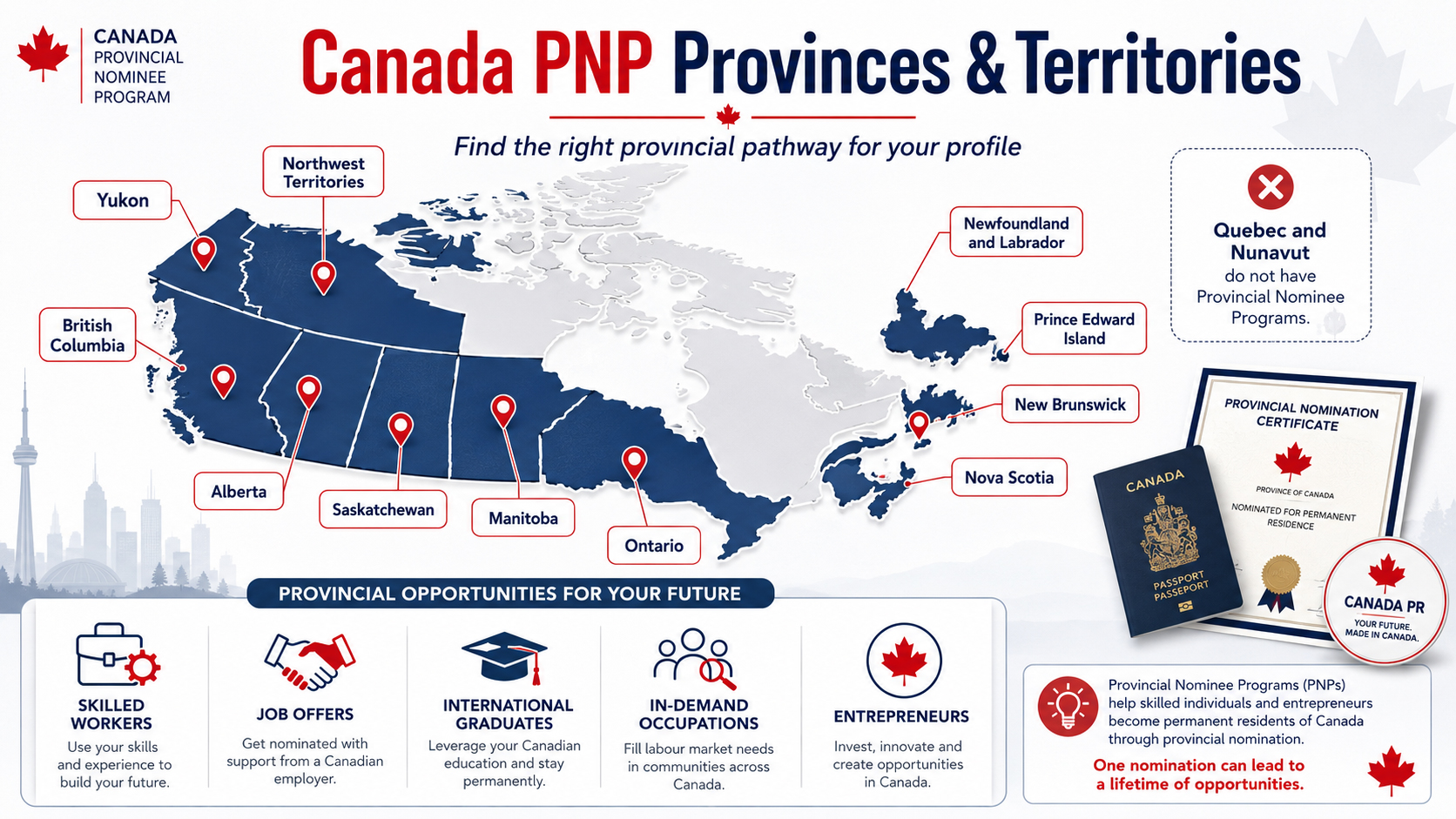
Most Canadian provinces and territories have PNP pathways. These include:
Alberta
British Columbia
Manitoba
New Brunswick
Newfoundland and Labrador
Northwest Territories
Nova Scotia
Ontario
Prince Edward Island
Saskatchewan
Yukon
Quebec and Nunavut do not have provincial nominee programs. Quebec has its own immigration system, and Nunavut does not operate a PNP.
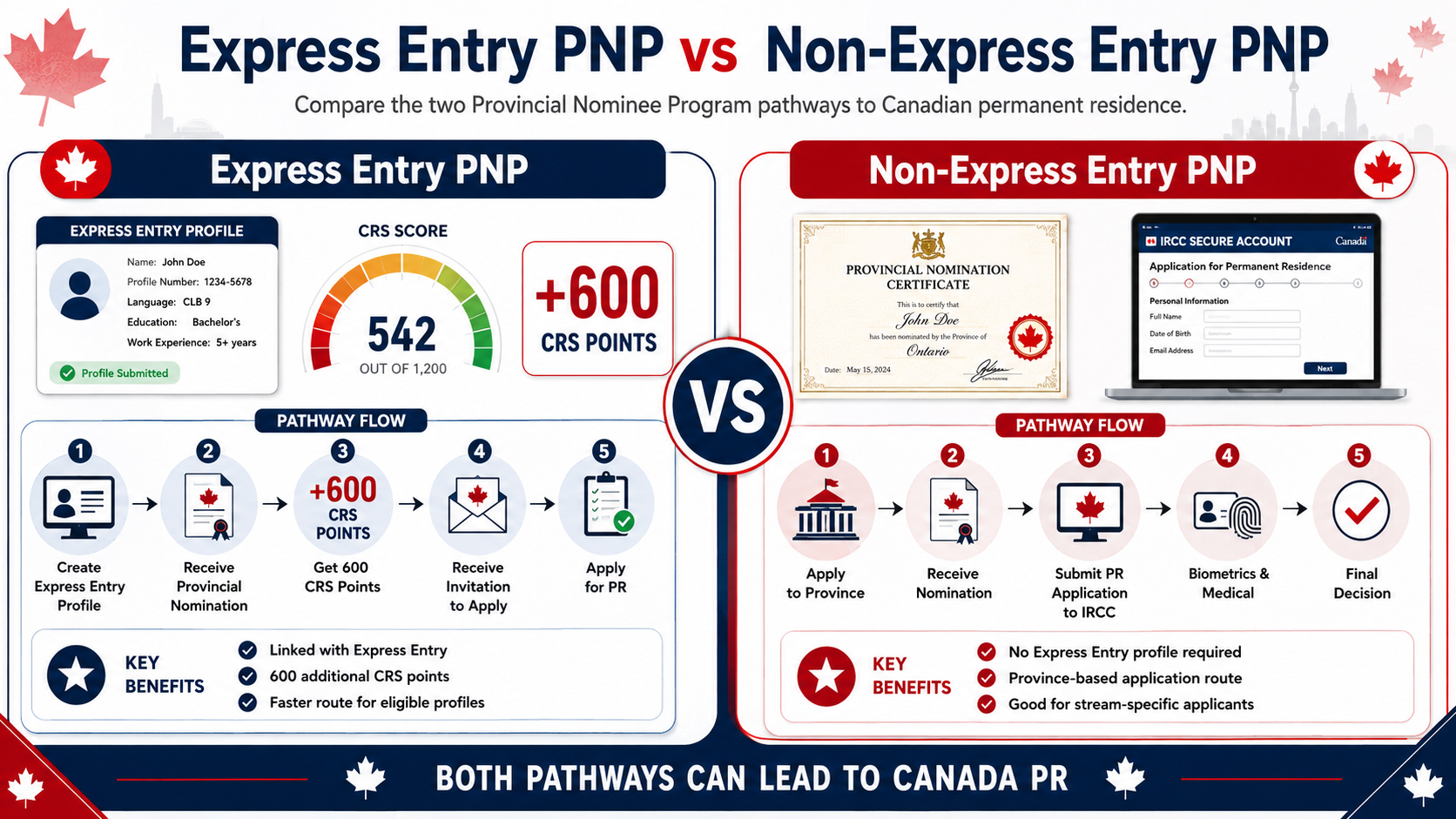
Two Main Ways to Apply Through PNP
There are two major PNP application routes:
Express Entry PNP
Non-Express Entry PNP
The right pathway depends on your profile and the province or territory’s stream requirements.
Express Entry PNP Process
Express Entry PNP is for applicants who qualify for both a provincial nominee stream and a federal Express Entry program. This is a powerful option for candidates who already have an Express Entry profile or are eligible to create one.
If a candidate receives a provincial nomination through an Express Entry-linked stream, they receive 600 additional CRS points, which can strongly improve their chance of receiving an Invitation to Apply for permanent residence.
How Express Entry PNP Works
The process usually works like this:
The applicant checks eligibility for Express Entry and a provincial stream.
The applicant creates an Express Entry profile.
The province may select the applicant from the Express Entry pool or the applicant may apply directly to the province, depending on the stream.
If approved, the province issues a nomination.
The applicant accepts the nomination in their Express Entry profile.
The CRS score increases by 600 points.
The applicant may receive an Invitation to Apply for permanent residence.
The applicant submits a full PR application to IRCC.
The CRS is the points-based system IRCC uses to assess, score, and rank Express Entry profiles in the pool.
Non-Express Entry PNP Process
Non-Express Entry PNP is for applicants who qualify for a province or territory’s PNP stream but do not apply through Express Entry. This route is often used for streams that are employer-driven, occupation-specific, graduate-focused, or designed for applicants outside the Express Entry system.
For non-Express Entry PNP, the applicant first applies to a province or territory. After receiving a nomination, the applicant can apply online for permanent residence through IRCC’s Permanent Residence Portal.
How Non-Express Entry PNP Works
The process usually follows these steps:
Choose the province or territory where you genuinely plan to live.
Select the correct PNP stream.
Check the eligibility requirements.
Prepare provincial application documents.
Submit the nomination application to the province.
Receive a nomination certificate if approved.
Submit the federal permanent residence application to IRCC.
Complete biometrics, medical exams, police certificates, and other requirements.
Wait for IRCC’s final decision.
IRCC processing times can vary depending on the type of application, whether the file is complete, how easily information can be verified, how quickly the applicant responds to requests, and other factors.
Common Types of PNP Streams
Each province has its own program structure, but many PNP streams fall into similar categories.
1. Skilled Worker Streams
Skilled worker streams are designed for applicants with work experience in occupations needed by a province. Some streams require a job offer, while others may target candidates from the Express Entry pool based on occupation, CRS score, or provincial priorities.
2. Employer Job Offer Streams
Employer-driven streams are for applicants who have a valid job offer from an eligible employer in the province. These streams usually require the employer and job offer to meet specific conditions.
3. International Graduate Streams
These streams support international students who completed eligible studies in Canada and want to settle in a specific province. Requirements may include education, job offer, language level, and intention to live in the province.
4. In-Demand Occupation Streams
Some provinces publish lists of occupations that are in demand. Applicants with experience in those occupations may have better opportunities if they meet the stream requirements.
5. Express Entry-Aligned Streams
These streams are connected to the federal Express Entry system. If nominated, the applicant can receive 600 additional CRS points, which can significantly strengthen the profile for an Invitation to Apply.
6. Entrepreneur and Business Streams
Entrepreneur streams are designed for applicants who plan to start, buy, or invest in a business in a province. These streams usually require business experience, investment capacity, a business plan, and a genuine intention to operate the business.
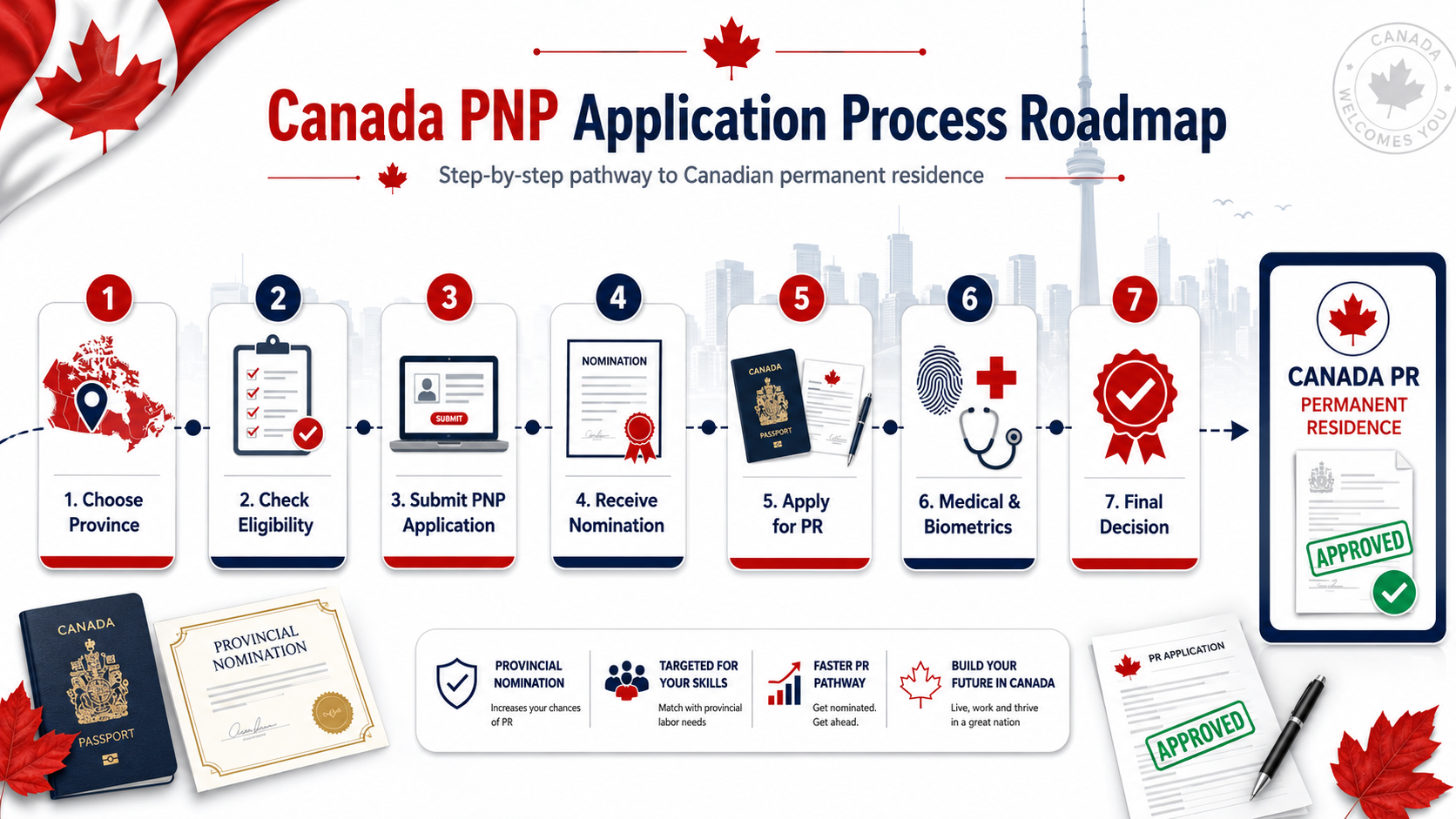
Step-by-Step PNP Application Process
Step 1: Choose the Right Province
The first step is to decide where you genuinely want to live and work in Canada. This is important because PNP is connected to provincial settlement intention. You should not choose a province only because it seems easier. Your education, occupation, job offer, family ties, work history, and long-term settlement plan should match the province.
IRCC states that non-Express Entry PNP applicants must decide where they want to live in Canada and apply under one of that province or territory’s streams.
Step 2: Check the Correct PNP Stream
Every province has multiple streams. Some are for skilled workers, some are for graduates, some are for entrepreneurs, and some are linked to Express Entry. You must carefully check the eligibility requirements before applying.
Important requirements may include:
Occupation or NOC code
Work experience
Language score
Education level
Job offer
Settlement funds
Connection to province
Employer eligibility
Intention to live in the province
Step 3: Prepare Your Documents
Document preparation is one of the most important parts of a PNP application. Missing, weak, or inconsistent documents can create delays or refusals.
Common documents may include:
Valid passport
Language test results
Educational documents
Educational Credential Assessment, if required
Work experience letters
Job offer letter, if required
Employer documents, if required
Proof of settlement funds
Resume or CV
Birth certificate
Marriage certificate, if applicable
Police certificates
Medical exam documents
Provincial forms
Settlement plan
Business plan, for entrepreneur streams
Step 4: Submit the Provincial Application
After preparing your documents, you submit your application to the province or territory. Some provinces use Expression of Interest systems, while others allow direct applications when a stream is open.
You must make sure all information is accurate and consistent. Your job title, job duties, employment dates, salary, education, address history, and family information should match across all documents.
Step 5: Receive a Provincial Nomination
If the province approves your application, you may receive a nomination certificate. This nomination allows you to move to the federal permanent residence stage.
For Express Entry PNP, the nomination can be added to your Express Entry profile. For non-Express Entry PNP, the nomination supports your PR application through the PR Portal.
Step 6: Apply for Permanent Residence
After nomination, you must apply to IRCC for permanent residence. A provincial nomination does not automatically make you a permanent resident. IRCC still reviews the federal application, including completeness, eligibility, medical admissibility, criminality, security, and other requirements.
For non-Express Entry PNP, IRCC says that after nomination, applicants can apply online for permanent residence through the Permanent Residence Portal.
Step 7: Complete Biometrics, Medical Exam, and Police Certificates
During federal processing, applicants may need to provide biometrics, medical exams, and police certificates. For permanent residence applications, IRCC states that applicants between 14 and 79 need to give fingerprints and a photo, even if they gave biometrics in the past and they are still valid.
IRCC also explains that applicants and family members must complete a medical exam, and health issues may affect the application if they are considered a danger to public health or safety or could cause excessive demand on health or social services.
Step 8: Wait for IRCC’s Final Decision
After submission, IRCC reviews whether the application is complete, whether the processing fee has been paid, whether requirements are met, and whether all documents are included. If the application is incomplete, IRCC may reject it and refund the processing fees.
If approved, the applicant may receive Confirmation of Permanent Residence, and depending on nationality, a permanent resident visa may also be issued.
PNP vs Express Entry: What Is the Difference?
Both Express Entry and PNP can lead to Canadian permanent residence, but they work differently.
| Topic | Express Entry | Provincial Nominee Program |
|---|---|---|
| Selection level | Federal system | Province or territory-based |
| Main selection factor | CRS score and program eligibility | Provincial labour market needs and stream requirements |
| Province-specific requirement | Not always required | Usually tied to a specific province or territory |
| Nomination benefit | Not applicable unless nominated | Express Entry PNP can add 600 CRS points |
| Best for | High CRS candidates | Candidates with provincial eligibility, job offer, occupation demand, or local connection |
PNP can be especially helpful for applicants who may not have a high enough CRS score for a regular Express Entry invitation but have skills or connections that match a province’s needs.
Benefits of the Provincial Nominee Program
The Provincial Nominee Program can offer several advantages for suitable applicants.
1. Strong Opportunity for Province-Specific Applicants
If your occupation, education, job offer, or background matches a province’s needs, PNP can create a more targeted pathway to permanent residence.
2. 600 CRS Points for Express Entry PNP
An Express Entry-linked provincial nomination gives 600 additional CRS points, which can make a major difference for candidates in the Express Entry pool.
3. Pathway for Applicants Outside Express Entry
Some applicants may not qualify for Express Entry but may still qualify under a non-Express Entry PNP stream. This can be useful for employer-supported applicants, semi-skilled workers, graduates, or candidates in province-specific streams.
4. Supports Local Settlement
PNP is designed to help applicants settle in a specific province or territory. This can be helpful for people who already have a job offer, family connection, education history, or work experience in that region.
Common Reasons PNP Applications May Be Refused
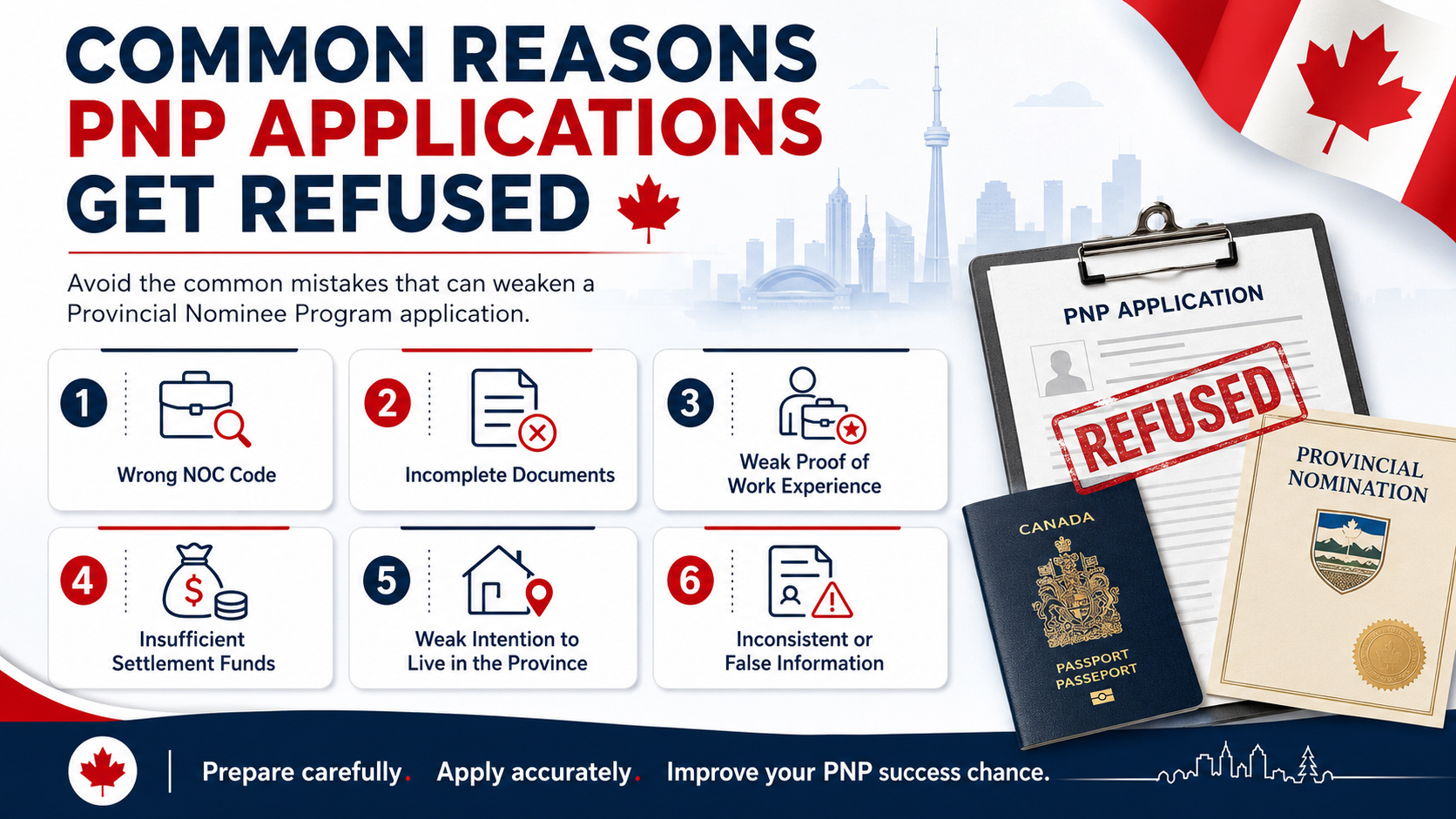
PNP applications can be refused or delayed for several reasons. Common issues include:
Wrong stream selection
Incomplete documents
Weak proof of work experience
Job duties not matching the claimed NOC code
Weak intention to live in the province
Invalid or expired language test results
Insufficient settlement funds
Employer not meeting provincial requirements
Inconsistent personal, education, or employment history
Misrepresentation or false information
Failure to respond to provincial or IRCC requests
Truthfulness is extremely important. IRCC warns that if an applicant is not truthful, the application may be refused, the person may be found inadmissible, and they may be barred from applying for permanent resident status for up to five years.
Tips to Improve Your PNP Application
A strong PNP application should be accurate, complete, and clearly connected to the province’s requirements.
1. Choose the Province Strategically
Do not apply randomly. Choose a province where your occupation, experience, education, or job offer fits the program requirements.
2. Use the Correct NOC Code
Your NOC code must match your actual job duties, not only your job title. Officers usually review duties carefully.
3. Prepare Strong Work Experience Letters
Employment letters should include job title, duties, salary, working hours, employment dates, employer contact details, and official company information.
4. Keep Documents Consistent
Dates, addresses, names, job titles, education details, and family information should be consistent across all forms and supporting documents.
5. Monitor Stream Openings
Some PNP streams open and close quickly. You should prepare documents early so you can apply when the correct stream becomes available.
6. Maintain a Genuine Settlement Plan
If you are applying to a province, your plan should show why you want to live there. This may include job prospects, family connection, study history, labour market fit, housing plans, or community ties.
How F.A.L. Immigration Services Ltd. Can Help
F.A.L. Immigration Services Ltd. can help you understand which PNP pathway may fit your profile. Our team can assist with eligibility review, province selection, NOC code review, document checklist preparation, work experience review, explanation letters, application strategy, and full application guidance.
Whether you are considering Express Entry PNP or non-Express Entry PNP, professional review can help reduce mistakes and improve the quality of your application package.
Final Thoughts
The Provincial Nominee Program is one of Canada’s most important immigration pathways for applicants who want to settle in a specific province or territory. It can help skilled workers, international graduates, job offer holders, entrepreneurs, and other eligible applicants move closer to Canadian permanent residence.
However, every province has different rules. A successful PNP application requires the right stream, accurate documents, strong proof of eligibility, and a genuine plan to live in the nominating province.
If you are planning to apply through the Provincial Nominee Program, take time to review your profile carefully before submitting your application.
Planning to apply for Canada PR through PNP? Book a consultation with F.A.L. Immigration Services Ltd. today and let our team help you find the right pathway for your profile.